Updates to Teosto’s membership agreement: A new category of rights concerning AI
The use of AI has increased in the music industry.At the same time, the AI market has developed, and licensing solutions have begun to emerge. To prepare for the future, Teosto is making changes to the administration of rights related to AI.
Teosto’s goal is to administer music-related rights in a flexible manner and comprehensively advocate for the interests of its rightholders – even in the age of AI. On 20 May 2026, Teosto’s General Assembly approved a new category of rights concerning AI. This brings changes to Teosto’s membership agreement.
The new AI-related category of rights makes it possible for you to accrue royalties when your works are used in AI services. The AI market is still emerging, and the first licensing models are currently being established. When your rights are included, your works can be part of these solutions from the start.
Teosto’s membership agreement as of 17 September 2026
- A new AI-related category of rights will be incorporated into the rights administered by Teosto. It includes both currently represented audible music as well as lyrics in graphic form in connection with AI. Lyrics in graphic form in AI use were approved for administration by Teosto in the General Assembly in the spring 2025.
- The members have also approved the adaptation right related to AI use as part of the new category of rights concerning AI. As a rightholder, you need to give separate consent for the administration of adaptation rights.
- The aim of the changes is to make it possible for our rightholders to receive royalties for the AI-related use of their works in the future.In order for Teosto to conclude comprehensive agreements on the use of music in AI services, we need to have the necessary rights assigned to our administration.
In connection with the rights category change, two new clarifying changes will be incorporated into the agreement (sections 9 and 13) which will not change current procedures. You can review the new membership agreement here.
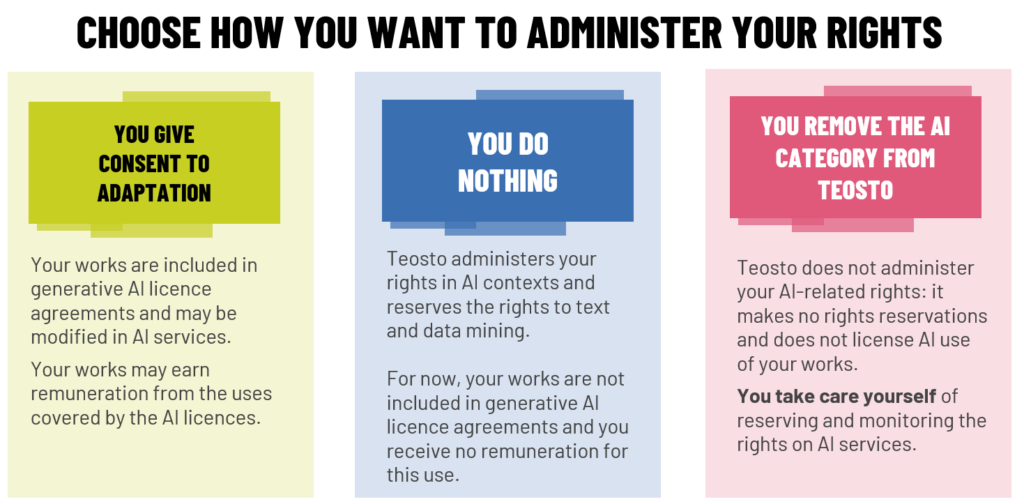
You decide on the administration of your rights
The new AI-related category of rights will enter into effect on 17 September 2026 and applies to all works administered by Teosto.
- The new membership agreement will enter into force automatically without the signing of a new agreement, and it will replace the previous agreement. If you do not want Teosto to represent your works in AI use, you have the option of removing the AI-related category of rights from Teosto’s administration before the change enters into effect. The notification of removal will be communicated by means of a form that will be available on Teosto’s web service starting from 17 August 2026.
- We need your consent for Teosto to also represent you with regard to adaptation rights related to AI use. Adaptation is one key way in which music is utilised in AI services. For us to conclude comprehensive agreements on the use of music in AI services, we need to have the necessary rights assigned to our administration. You can communicate your consent by means of a form that will be available on Teosto’s web service starting from 17 August 2026.
- If your works are published, please check your publishing agreement and if needed, discuss with your publisher. Please make sure that you can assign the administration of the rights covered by the new AI-related category of rights to Teosto without being restricted by your publishing agreement. If you are unable to assign the new AI-related category of rights to Teosto’s administration in full (e.g. lyrics in graphic form), you need to submit a notification regarding its removal. A removal will be communicated by means of a form that will be available on Teosto’s web service starting from 17 August 2026.
- Notifications and consents by heirs are submitted by the heirs’ contact person using the same form available in the web service as of 17 August 2026.
Questions and answers about the administration of AI-related rights for music
The new AI-related category of rights and assigning comprehensive rights related to the category make it possible for Teosto to conclude licensing deals with AI services and collect royalties on behalf of its customers for the AI-related use of their works. At the same time, it allows Teosto to protect your rights more effectively by reserving the rights related to works with regard to both music and graphic representations of lyrics. Reserving the rights means that the works cannot be used without permission for text and data mining (Copyright Act, section 13b), which is one of the limitations of copyright and may be part of the training of AI.
Adaptation is one key way in which music is utilised in AI services. It is also an area that is expected to account for a significant share of royalties. Assigning adaptation rights to Teosto’s administration makes it possible to include works in licensing deals related to AI use when Teosto concludes such agreements in the future, either directly or through its licensing partners (such as ICE Core). When it comes to such agreements, Teosto always advocates for the collective interest of our rightholders.
If all of your rights covered by the new AI-related category of rights are administered by Teosto, we can also conclude agreements with AI services with regard to the training of AI models.
The adaptation rights assigned to Teosto’s administration only apply to AI-related contexts. Adaptation is one key way in which music is utilised in AI services. Assigning adaptation rights to Teosto’s administration is a prerequisite for Teosto to be able to conclude comprehensive agreements with AI services concerning the use of your works.
Adaptation means that works can be used in various ways to generate AI music in generative AI services. A service can produce AI music based on text prompts, and the music thereby generated may resemble the original work to some extent. For example, different works may be combined with each other, the genre may be changed, or the user’s own lyrics may be added to works.
At present, AI music generated by many generative AI services can only be used within the service. However, it is possible that, in the future, AI music generated by the users of the services may also be distributed outside the services. In such cases, separate royalties and other conditions will be agreed upon in connection with such distribution.
No. As is the case with other categories of rights, the category of rights related to AI cannot be broken down into multiple parts. If a rightholder does not want to assign the administration of rights concerning graphic representations of lyrics to Teosto, the rightholder must remove the AI-related category of rights from Teosto’s administration entirely. This means that Teosto will also not administer the AI use of the rightholder’s works in audio form.
No, you cannot. Assigning the AI-related category of rights to Teosto’s administration currently applies to the rightholder’s entire repertoire, and individual works cannot be separated from it. The same applies to the adaptation right in AI contexts. If you wish to remove individual works from AI use, you must remove them from Teosto’s administration entirely in accordance with Teosto’s existing self-administration arrangements. In this case, you will not receive any royalties for these works through Teosto for any other use either.
Teosto can only include in its agreements and licences the shares it administers in the AI-related category of rights. If a co-creator removes their AI-related category of rights from Teosto’s administration, Teosto cannot conclude agreements on the use of works on behalf of the creator in question. When your AI-related category of rights is under Teosto’s administration, Teosto will, however, represent the works with respect to your shares.
Teosto’s role is to ensure that the interests of our rightholders are taken into account in licensing deals. Teosto agrees on your behalf on the relevant terms and conditions, such as where the AI music generated can be used, and royalties related to such use.
In its agreements concerning AI-related use, Teosto aims to ensure that the service provider provides reports appropriate for the purpose of distributions on the use of works in the service.
As the market is still in its emergent stage, the practices are not yet clear. At present, AI music created in many generative AI services can only be used within the service. However, it is possible that, in the future, AI music generated by the users of the services may also be distributed outside the services; for example, in social media. This requires that the matter is agreed upon in licensing deals concluded with AI services.
On the basis of the moral rights stipulated by the Copyright Act, the creator has the right to prohibit the use of their work in contexts that are offensive or prejudicial to the creator’s reputation. Whether a context is offensive or prejudicial to the creator’s reputation is assessed by objective criteria in accordance with the Copyright Act. As moral rights are not within the scope of Teosto’s administration of rights, the member must make any such claims directly to the platform in question.
The rights represented by Teosto and record companies concern the rights of different groups of rightholders. Each entity representing rightholders concludes agreements with AI services on the exercise of rights for their part. Agreements concluded by record companies relate to the recording rights of works, while Teosto represents the copyright of works, i.e. composers, lyricists, arrangers and publishers. The AI service in question is responsible for ensuring that it has secured licences for the use of protected content from all of the relevant rightholders. In order for an AI service to have all of the rights it is required to have, it needs to also sign an agreement with the entity that represents creators and publishers.
The key consideration is how the works are used in these contexts. For example, on Spotify, music represented by Teosto will continue to be licensed for normal streaming by our licensing partner ICE Core. If services with which we have previously concluded licensing deals want to introduce generative AI features that enable the production of AI music based on original works, they need to separately agree with us on such use.
Teosto is currently actively promoting discussions with AI services. As is typical of all contract negotiations, we cannot comment on them while the negotiations are ongoing.
Teosto negotiates licensing deals with AI companies either directly or through its licensing partners (such as ICE Core). The agreements cover the scope of the use of works, the royalties to be paid, and reporting.
The agreements may set out restrictions on how works can be used in the AI service and how royalties are paid for the works used. The agreements may also specify that AI music generated in the service can only be used within the service. Even if licensing deals in the first stage limit the use of AI adaptations so that they can only be used within the service, it is possible that future agreements will include more detailed provisions on the distribution of AI adaptations outside the service. The market practices related to AI licensing are still developing, and Teosto will keep a close eye on any developments.
Teosto’s distribution principles are set out in the Distribution Rules, which are decided on by the General Meeting. Any amendments to the Teosto Distribution Rules will be decided on separately by the General Meeting when distributable royalties have been accrued. At this stage, the change concerning the category of rights does not affect distributions, the Distribution Rules or royalties paid.
In its agreements concerning AI-related use, Teosto aims to ensure that the service provider provides reports appropriate for the purpose of distributions on the use of works, and these reports will be used as the basis for the distribution of royalties.