Music Listening in Finland 2026: the smartphone again increased its lead as the most popular device for listening to music – big differences seen in music listening between young people and those above 60 years of age
The smartphone further strengthened its position as the most important device for listening to music among Finns. At the same time, discovering music through TikTok, Instagram and other social media services increased, especially among young people. These are among the findings of the newly published Music Listening in Finland 2026 report by IFPI Finland and Teosto.
When asked about which devices they have used to listen to music during the past week, 75% of Finns stated they had used a smartphone and 73% said they had used a car radio. When it comes to daily use, the smartphone overtook the car radio for the first time as the most common device for listening to music, although the car radio maintained its steady popularity among Finns of all ages.
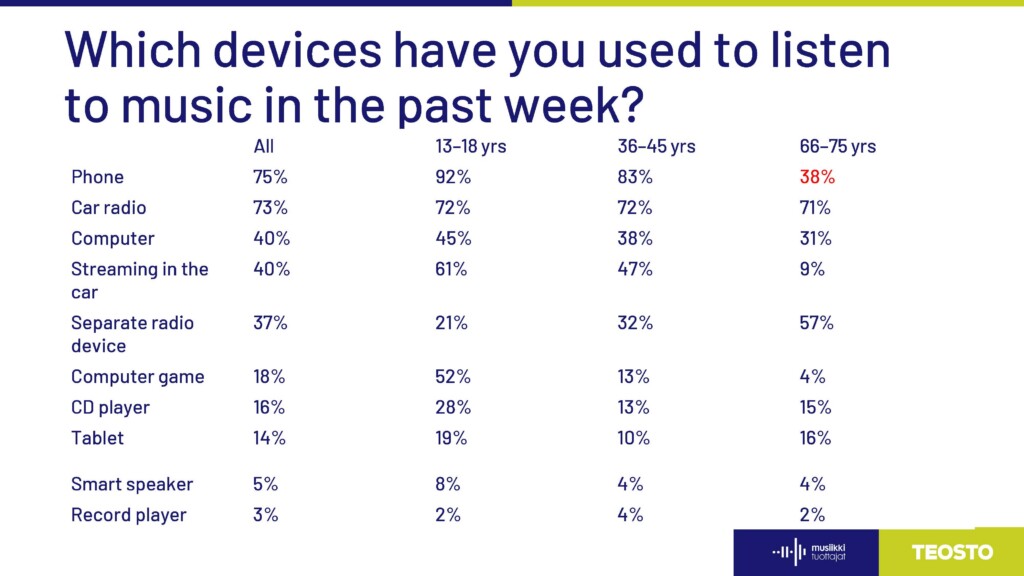
Music Listening Devices in Finland 2026. Source: Music Listening in Finland 2026 report.
Nevertheless, music listening habits are becoming increasingly different between younger and older age groups. Among the 13–18 age group, as many as 92% stated that they had listened to music on a smartphone during the past week, compared to only 38% among the 66–75 age group. The radio, in turn, maintained its strong position among older age groups: in the 66–75 age group, 71% used a car radio and as many as 57% used a separate radio device. In the 13–18 age group, only one in five respondents used a separate radio device.
“The digitalisation of Finnish music consumption has largely already taken place. In my view, the development of the music market is no longer defined by the transition from physical formats to digital services, but rather by competition for people’s time, attention and sense of community. The period of strongest growth in the number of users of streaming services appears to be behind us, and this goes for both the young and middle-aged groups,” says researcher Kari Tervonen from Omnicom Media Group.
Listening to music on TikTok or Instagram also continued to grow. When asked about their service use during the past week, as many as 43% of Finns stated they had listened to music on social media channels. In the 13–18 age group, this figure was as high as 82%.
“Social media has permanently changed the way the younger generation, in particular, discovers new artists and songs. Many hits first gain exposure on short-form video platforms before radio stations or the playlists of streaming services,” Tervonen says.
As music listening becomes increasingly digital, revenues in the music industry appear likely to become increasingly reliant on gigs and festivals. According to Kari Tervonen, the number of visitors to live gigs showed a slight decrease from the previous year’s study, although there is still interest in live gigs. Half of Finns stated they had attended a gig or concert during this year, and 68% stated they had done so during the past two years.
“It is increasingly difficult for Finland to compete for live gigs by leading international stars. The audiences’ ability to spend also remains a challenge. People are considering how many gigs or festivals they can afford to attend.”
Young people and people over 60 years of age are two different music markets
Music consumption among Finns has become highly digitalised and is partly intertwined with how they spend their time on other digital activities. Especially among younger people, music is intertwined with watching short-form videos and browsing social media, but it is also quite strongly intertwined with games.
The use of vinyl record players and CD players is concentrated among certain groups of enthusiasts, for many of whom using these devices represents a special occasion for more focused listening. In 2026, physical recordings are primarily premium products and collector’s items for a few hundred thousand people.
Young people (ages 13–25)
- Listen to music on their phone.
- Actively use streaming services and social media channels.
- Prefer hip hop, rap, EDM and K-pop.
The in-between age group (ages 26–59)
- Use phone, computer and radio in parallel.
- An important audience for gigs and has the most diverse taste in music.
- This age group resembles the younger group at the younger end of the age range and the older group at the older end.
Older people (ages 60–75)
- The importance of radio, Finnish schlager and rock is more pronounced.
- Among less mainstream genres, classical music and jazz draw their audiences from this age group.
- The use of physical recordings is relatively more common in this age group than among the younger age groups.
Teosto’s and IFPI Finland’s Music Listening in Finland 2026 survey provides information about changes in Finns’ music listening habits over the longer term for the 13th time. The lead researcher was Kari Tervonen, Omnicom Media Group’s Roadmap Director, supported by Johanna Laitinen from Teosto and Tommi Kyyrä from IFPI Finland.