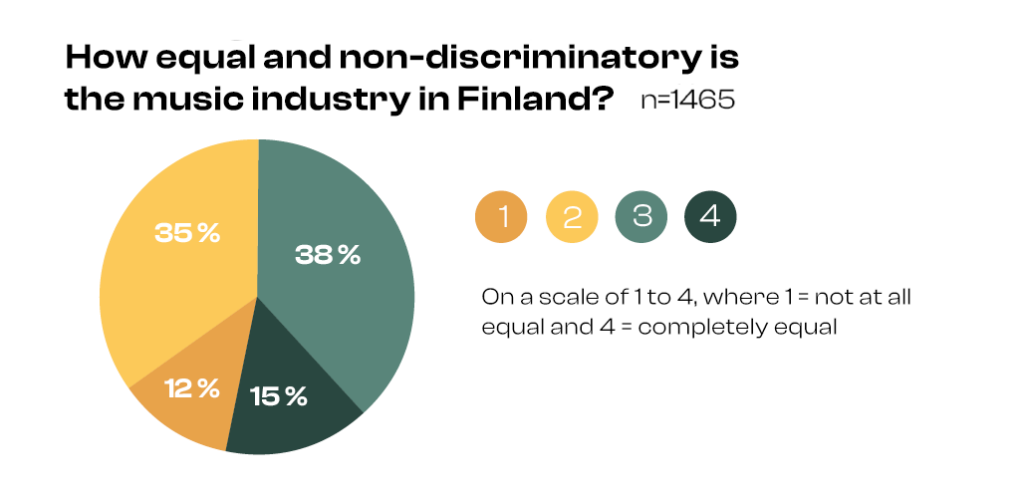
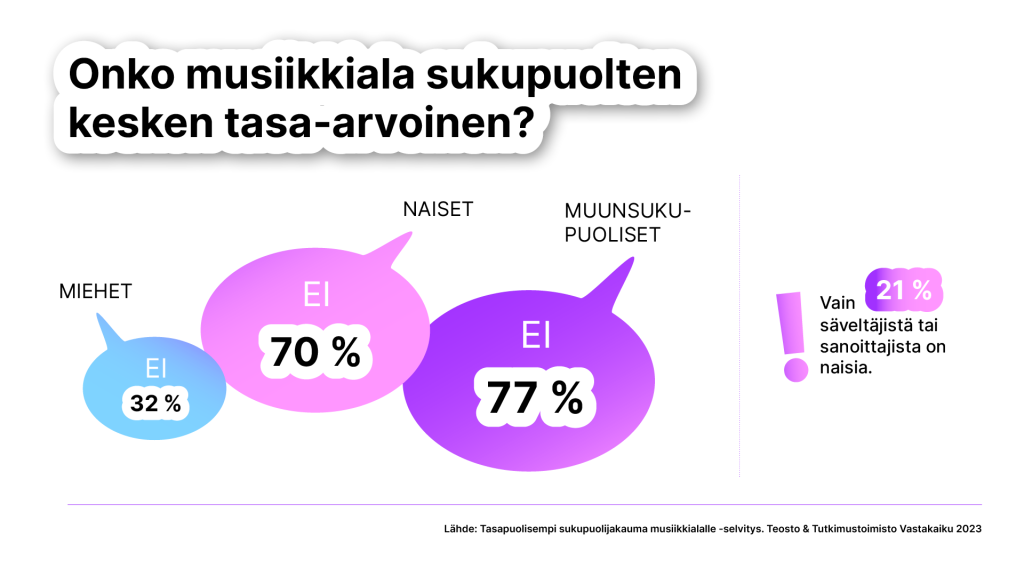
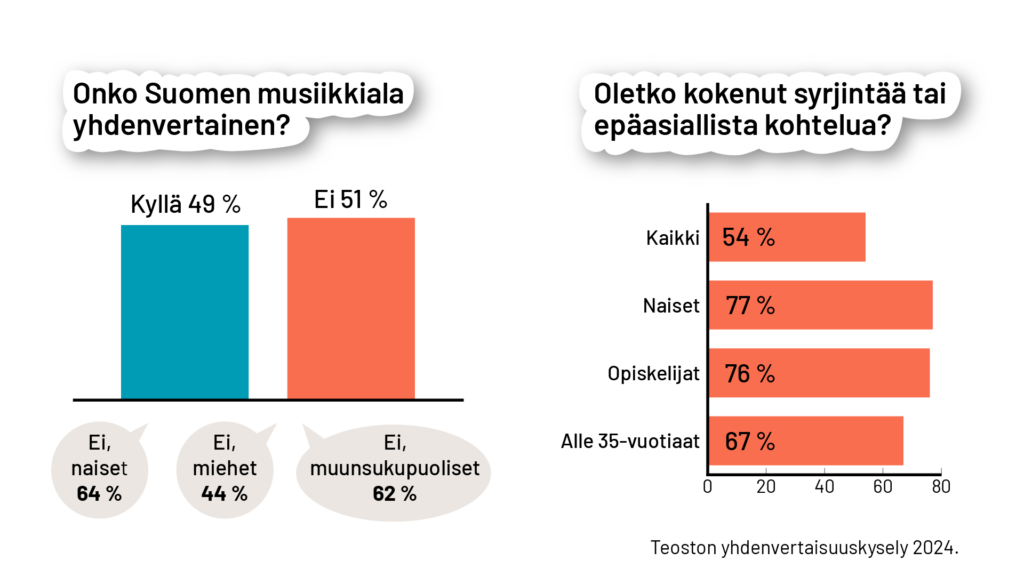
The position of women in the music industry is improving slowly – shares of royalties are increasing
The gender distribution in the Finnish music industry is still changing very slowly. The proportion of women among music creators, performers and producers only grows in small increments from year to year. However, the distributions paid to women are increasing more than the proportion of women. Although the differences are still large, both Teosto’s and Gramex’s statistics show that women’s visibility and earnings in the Finnish music industry are increasing.
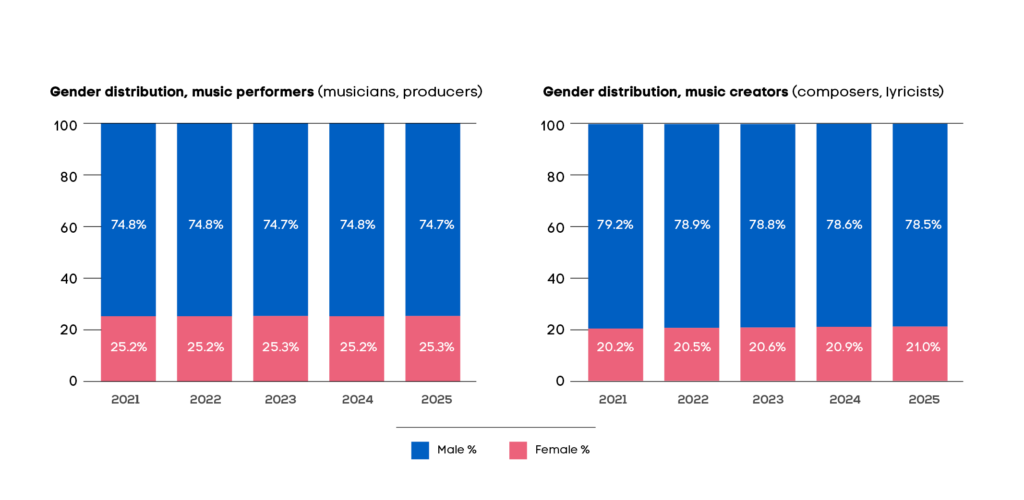
In 2025, women accounted for 25.3% of music performers and producers (2024: 25.2%) and 21.0% of music creators (2024: 20.9%). Although the changes are taking place slowly, the statistics of both Teosto and Gramex show that the development is continuing in the same direction. The proportion of women among the new music creators who joined Teosto in 2025 is 25.4%.
Changes become visible slowly due to the long history behind the figures. Both Teosto memberships and Gramex memberships are valid for life. A large proportion of the members of both societies no longer actively work with music, but their impact on the statistics remains.
Vappu Aura, Director of Communications, Marketing and Public Relations at Teosto, says that, in recent years, music industry players have worked actively to change perceptions and eliminate discrimination.
“It is important to note that the difference narrows year by year. This development is slow, but it is going in the right direction. We want everyone who wants to work in the music industry to feel that it is possible for them to do so.”
The proportion of women is about the same in all the Nordic countries as well as elsewhere in Europe. For example, in Sweden, women account for 22% of music creators, and in Denmark, they account for 21%. In order to improve the situation, numerous global networks have been established, such as the Nordic Female Songwriters Day, the European Keychange and the global Shesaid.so, in which Finnish players are also involved.
Income gaps between women and men are narrowing
Women’s share of the money is still lower than their proportion of music professionals. In 2025, 15.4% of the royalties paid by Teosto to music creators were distributed to women. The situation is slightly better when it comes to the performer and producer royalties paid by Gramex: 22.2% of these were distributed to female musicians or producers. However, there was an increase in both shares that clearly exceeds the growth in the proportion of women.
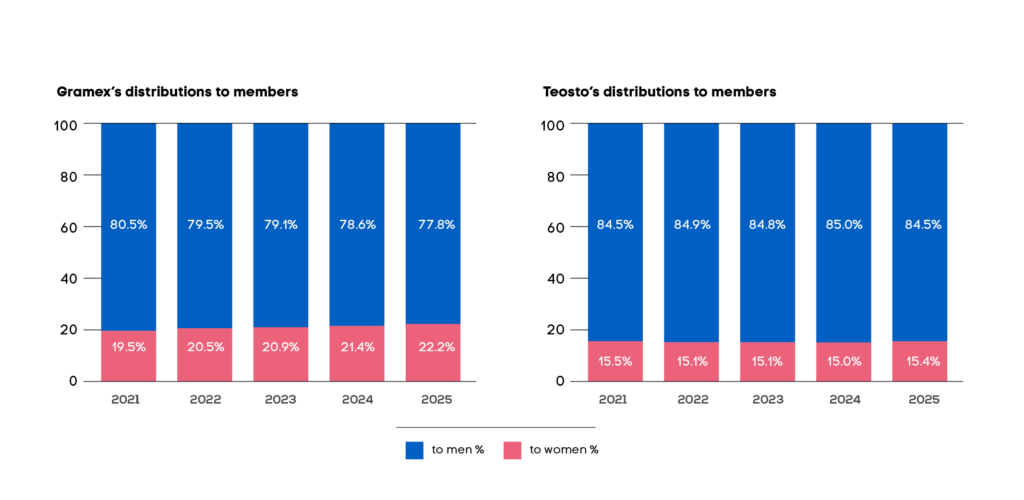
“Women are active both as music creators and as performers and make great music! The statistics are greatly impacted by history, but the development shows that women’s contributions are also clearly increasing in financial terms,” says Noora Marttila, Communications Manager at Gramex.
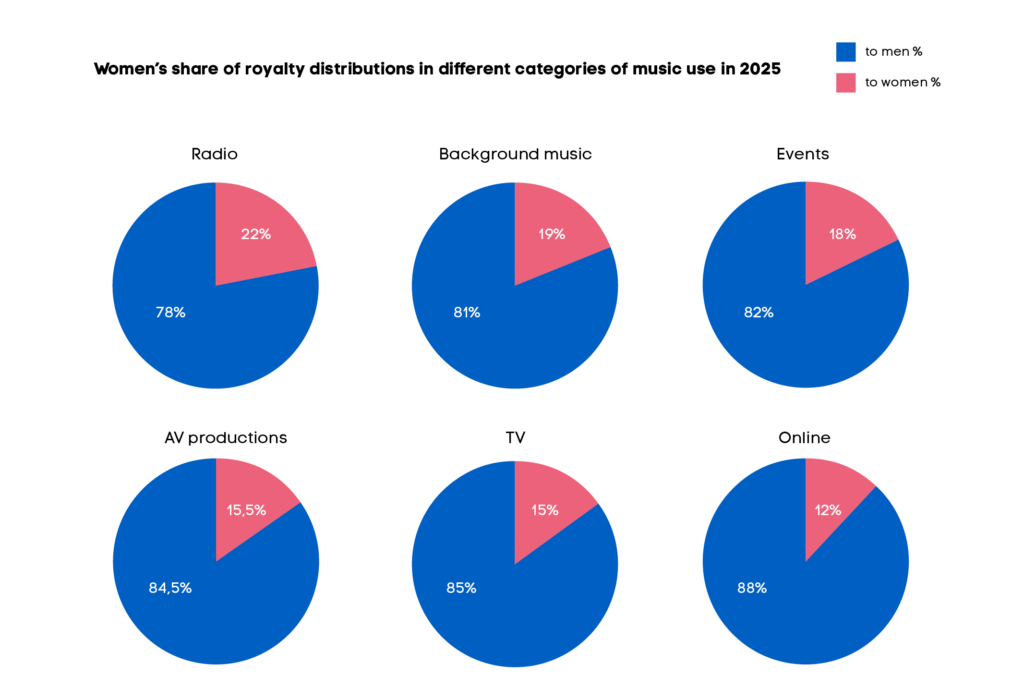
Certain channels seem to be particularly favourable to women. Of the royalties paid for radio play, 21.6% were allocated to women, which is one percentage point higher than in the previous year. The strongest growth was in royalties paid for live music, where the women’s share was 17.9% – an increase of 1.6 percentage points from last year. In the online area of digital channels, however, the women’s share is just over 10% of all royalties.
According to Teosto’s statistics, there are also more successful women who have reached the top. In the group earning more than EUR 20,000 per year, the proportion of women was 14.9%, compared to 13.8% a year earlier. The proportion of women among the creators of hit songs is also increasing: 16% of the creators of the 100 most played songs were women (15% a year earlier).
The number of songs decreased for both genders
The number of works decreased in 2025 for both genders. On average, female composers and lyricists have 5.7 works in Teosto’s work register, while male composers and lyricists have 8. Both figures fell by 0.3 year-on-year. On average, the number of works registered in the Gramex phonogram register was 26.4 for women and 55.6 for men.
Only about one in ten (9.6%) works were created solely by women. Among musicians and producers, all-female teams are even more rare: According to Gramex’s phonogram reports, only 5% phonograms involve only women.
Music interests women – yet it is becoming a profession for fewer and fewer
Previous non-discrimination surveys have shown that the low number of women in the music industry is not due to a lack of interest. In 2025, 54 percent of music students were women. Their share was highest in higher education institutions and universities of applied sciences, where women accounted for 58 percent of students. In vocational education, the share of women was 47 percent.
Where these women go after graduation is an interesting question.
“Cuts to the cultural sector in recent years and the worsened job market have meant that fewer and fewer music students have the opportunity to make music for a living. In a small country like Finland, we can’t afford to waste the enormous potential of our high-quality music education – both for women and men,” says Teosto’s Vappu Aura.